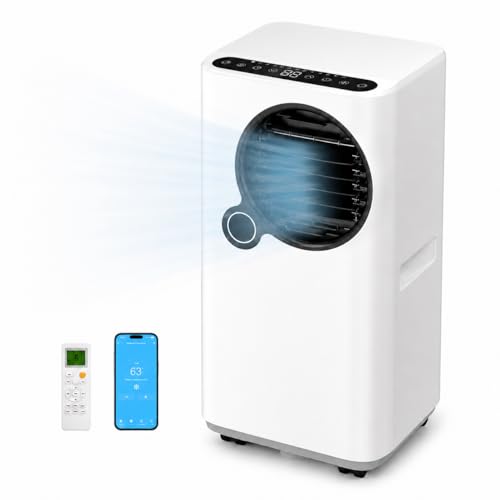
Cooling a large room means buying enough BTU — most portable air conditioner listings cap below what a 500+ sq.ft space needs. This roundup compares high-BTU portable AC units built for living rooms, open kitchens and big bedrooms, ranked on real cooling output, noise floor and footprint. The best portable air conditioner picks when one unit has to cool a whole room.
As an Amazon Associate I earn from qualifying purchases at no cost to you – it keeps the site running.
Overview The Gasbye is a dual-hose, full DC inverter portable air conditioner — the most efficient way to cool a large room. Dual hoses keep cooling from pulling warm air back in, and the DC inverter compressor runs quieter and uses less power than fixed-speed units. The premium large-room portable AC unit pick.
Dual-hose is the spec that matters for large rooms — single-hose units create negative pressure that sucks warm air in from other rooms, so they struggle to hold temperature in big spaces. Gasbye's dual-hose design eliminates that, and the full DC inverter compressor modulates output instead of cycling on/off, which means quieter operation, steadier temperatures and lower energy bills over a long cooling season.
It is the priciest unit here, and dual-hose install takes a bit more window setup. But for actually cooling a large room efficiently — not just rated BTU on paper — it is the best-engineered pick, and it ships with an active offer through end of year.
Pros
Dual-hose design — no warm-air backdraft, holds temp in big rooms
Full DC inverter — quieter, steadier, lower power draw
Premium build for whole-season use
Active manufacturer offer through 2026-12-31
Cons
Highest price in the comparison
Dual-hose window install takes a bit more setup
Best for Buyers who want the most efficient, quietest way to actually cool a large room.
Overview: Dreo's 516S is a 14,000 BTU ASHRAE (10,000 BTU DOE-certified) portable air conditioner built for large living rooms and open-plan spaces up to 500 sq.ft. Like the smaller 319S, it features Dreo's patented drainage-free system — the built-in algorithm and pump automatically evaporate condensate through the exhaust, eliminating manual water management during extended operation. Full smart-home integration — Dreo app, Siri, Amazon Alexa, and Google Home — combined with Dreo's noise-isolated engineering makes this the premium option in the large-room portable AC category.
At 14,000 BTU ASHRAE (10,000 BTU DOE/SACC), the 516S covers large rooms up to 500 sq.ft with the genuine cooling capacity the DOE number represents under real-world conditions. This positions it above the 8,000–10,000 BTU DOE effective range of standard 14,000 BTU ASHRAE alternatives — the 516S is DOE-certified, meaning the capacity claim reflects standardized real-world testing rather than the inflated ASHRAE lab conditions. For an open-plan living room, combined kitchen-dining area, or large master suite, the 516S reaches setpoint temperature effectively without cycling continuously at full load.
Dreo's drainage-free advantage is compounded at the large-room tier where runtime is typically longer. A 14,000 BTU unit running 8–10 hours daily in a humid climate fills its condensate reservoir faster than a bedroom unit, making the drainage-free system proportionally more valuable. The Noise Isolation System operates at 45 dB — unusually quiet for a 14,000 BTU unit — and the smart integration allows monitoring and scheduling through the Dreo app or voice commands via Alexa, Google Home, or Siri. The premium price over value-positioned alternatives reflects Dreo's component quality, drainage-free patent, and smart platform; buyers who run this unit daily through multiple cooling seasons will find the efficiency and convenience differentiation compounds over time.
Pros
Dreo premium brand — proven noise engineering and build quality above value brands
14,000 BTU ASHRAE / 10,000 BTU DOE-certified — accurate real-world capacity for large spaces
Drainage-free system — automatic condensate evaporation, no manual water tank emptying
Full smart-home control — Dreo app, Siri, Alexa, Google Home, and remote included
45 dB noise level — quiet for a large-room 14,000 BTU unit
Cons
Premium price — highest cost in the 14,000 BTU tier of this comparison
Single-hose design — dual-hose setup would improve efficiency further in well-sealed rooms
Best for Large living rooms, open-plan spaces, and combined areas up to 500 sq.ft where buyers want Dreo's drainage-free convenience, smart-home integration, and premium quiet engineering at the 14,000 BTU tier.
Overview: QZMDSM leads this comparison on raw BTU output with a 16,000 BTU ASHRAE rating – the highest capacity portable AC in this roundup. For larger spaces in the 600–800 sq.ft range or rooms with elevated heat loads (west-facing, high ceilings, poorly insulated), QZMDSM provides the headroom that 14,000 BTU units cannot. The trade-off is higher energy draw and larger physical footprint versus the 14,000 BTU alternatives.
QZMDSM's differentiation in this comparison is BTU headroom. 16,000 BTU ASHRAE (approximately 10,000–12,000 BTU DOE equivalent) enables cooling of larger or higher-heat-load spaces that 14,000 BTU units would struggle with during peak afternoon conditions. For buyers in climates with sustained high temperatures or rooms with significant solar gain, the extra BTU capacity means the unit reaches and maintains setpoint temperature without cycling at full capacity continuously – a factor in both comfort and component longevity.
The practical considerations for 16K vs. 14K BTU portable ACs: higher peak energy consumption (typically 1,400–1,600W vs. 1,200–1,400W), larger physical dimensions requiring more floor space, and slightly higher acoustic output at maximum capacity. For rooms that genuinely need 16,000 BTU ASHRAE coverage, QZMDSM provides the top-tier capacity in this comparison; for standard large rooms at the 400–600 sq.ft range, the 14,000 BTU alternatives provide equivalent comfort without the additional overhead.
Pros
16,000 BTU ASHRAE – highest capacity in this comparison, covers 600–800 sq.ft spaces
Additional cooling headroom for high-heat-load environments (west-facing rooms, poor insulation, high ceilings)
Handles peak summer temperatures that 14,000 BTU units cycle continuously through
3-in-1 cooling, fan, and dehumidifier modes
Cons
Higher energy consumption than 14,000 BTU alternatives at equivalent settings
Larger physical footprint – requires more floor space than lower-BTU portable ACs
Excess capacity for standard 400–600 sq.ft rooms – buyers pay for BTUs they may not need
QZMDSM is a value-brand positioning without established track record
Best for Buyers with genuinely large spaces (600–800 sq.ft) or elevated heat loads who need maximum BTU capacity in a portable form factor and can accept higher energy draw versus 14K BTU alternatives.
Overview: ZAFRO brings inverter compressor technology to the portable AC category – a meaningful differentiation from the fixed-speed compressors in the other units in this comparison. Inverter technology modulates compressor speed to match real-time cooling demand rather than cycling on/off at full capacity, resulting in more consistent temperatures, quieter operation at partial load, and lower energy consumption during sustained runtime.
ZAFRO's inverter compressor is the technical differentiator in this comparison. Standard portable ACs use fixed-speed compressors that cycle on at full power, cool the room, shut off, then restart when temperature rises – a pattern that creates temperature fluctuation, higher peak energy draw, and more wear cycles on the compressor. Inverter technology modulates output continuously: the compressor slows when the setpoint is nearly reached and ramps up when demand increases, maintaining tighter temperature bands with lower energy consumption during the sustained runtime periods that matter most in a portable AC context.
The dual-hose design adds a second practical advantage: standard single-hose portable ACs exhaust hot air out while drawing replacement air from the cooled room, creating slight negative pressure that pulls warm outside air through gaps around doors and windows. ZAFRO's dual-hose design takes intake air from outside and exhausts it outside, eliminating this infiltration inefficiency. For sealed or well-insulated rooms, the efficiency difference is measurable. The premium price over fixed-speed alternatives in this comparison reflects both the inverter component cost and the dual-hose design – buyers who run their portable AC for extended periods daily during cooling season can expect the efficiency gains to partially offset the price differential over time.
Pros
Inverter compressor modulates output for consistent temperature and quieter partial-load operation
Dual-hose design eliminates warm air infiltration – more efficient than single-hose alternatives
Lower energy consumption during sustained runtime vs. fixed-speed compressors
Fewer compressor on/off cycles reduces long-term wear versus fixed-speed units
Smart controls with app connectivity for remote temperature management
Cons
Premium price over fixed-speed 14,000 BTU alternatives in this comparison
Dual-hose installation requires two exhaust connections vs. single-hose simplicity
Inverter efficiency gains require sustained runtime to offset price premium – less favorable for occasional use
Best for Buyers who run their portable AC for extended daily periods and want the efficiency, temperature consistency, and noise reduction of inverter technology at a premium over standard fixed-speed portable ACs.