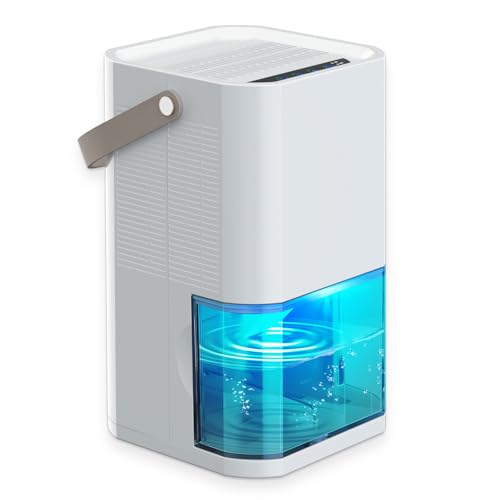
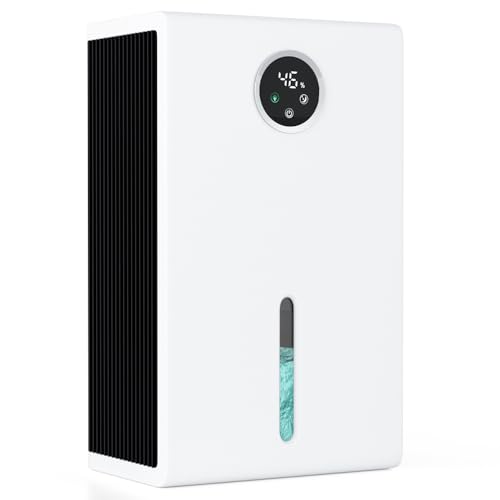
Overview: Frizzlife DH80 is a semiconductor dehumidifier with a built-in air purifying function, 135oz water tank, and 7-color LED lighting for small spaces. Rather than targeting a fixed humidity percentage, it reads the room's actual temperature and humidity and balances moisture adaptively, with sleep mode for quiet overnight operation.
The built-in air purifying function is the most distinctive feature in this comparison. Most small dehumidifiers simply extract moisture – the DH80 adds a filtration layer that removes airborne particulates alongside humidity control, which is relevant for users in spaces where dust, allergens, or pet dander are a concern alongside dampness. This effectively makes it a 2-in-1 device rather than a pure dehumidifier, which changes the value calculus for buyers who would otherwise need both.
Semiconductor (Peltier) technology operates without a compressor, which means no vibration and lower operating noise – the primary reason buyers choose semiconductor units for bedrooms and enclosed spaces. The DH80's adaptive humidity balancing reads room conditions and adjusts rather than cycling on and off to a fixed set point, which tends to produce more stable humidity in varying ambient conditions. The 135oz tank is large for the semiconductor category and reduces how often users need to empty it during normal operation.
Pros
Built-in air purifying function – 2-in-1 dehumidification and air filtration in one compact unit
Semiconductor operation means no compressor noise or vibration – genuinely quiet for bedroom use
135oz tank is large for the semiconductor class – reduced emptying frequency
Adaptive humidity balancing reads room conditions rather than cycling to a fixed set point
Sleep mode and 7-color LED add overnight usability and ambient lighting
Cons
Cannot manually set a specific humidity percentage – less precise control for users who want a target RH
Semiconductor technology extracts significantly less moisture than compressor alternatives – strictly for small spaces
Air purifying function supplements rather than replaces a dedicated air purifier in high-pollution environments
Best for Small bedroom, bathroom, or home office users who want a quiet 2-in-1 dehumidifier with air purifying capability and don't need to hit a precise humidity target.
Overview: The Kesnos 2,500 Sq.Ft Dehumidifier is Energy Star 2025 certified and removes up to 30 pints daily (at 95°F, 90% RH), reaching humidity levels as low as 30% RH versus the 40% floor of most competitors. At 36 dB it is among the quietest compressor dehumidifiers available, with four pre-set modes, auto defrost, timer, and included drain hose.
What separates the Kesnos from the semiconductor-class units in this lineup is real compressor extraction without whole-home noise levels. A Peltier or mini unit in a 200–400 sq.ft bedroom may run continuously and still struggle after showers or in humid climates; the Kesnos reaches a set RH faster and holds it with headroom from its 2500 sq.ft rating, so it typically cycles rather than running at peak in a small room — which also keeps operating noise closer to the 36 dB spec than a compressor maxed out in an oversized space.
Energy Star 2025 certification matters even in smaller rooms when the unit runs most of the day through a humid season. Four pre-set modes (Comfort, Dry, Continuous, Turbo) cover overnight bedroom use, laundry drying, and aggressive initial dry-down without manual tweaking. The 0.39-gallon tank is small relative to coverage, so the included drain hose is the practical path for anyone running the unit daily — same pattern as larger compressors in this comparison, scaled to a footprint that still fits a bedroom corner or bathroom alcove.
Pros
Energy Star 2025 certified — current efficiency standard for extended seasonal run-time
36 dB compressor operation — quieter than typical basement units, viable near sleeping areas
Reaches 30% RH versus the 40% floor of many small-room alternatives
Compressor extraction significantly outperforms semiconductor units in this comparison
Four pre-set modes plus auto defrost — scenario-based use without constant manual adjustment
Drain hose included — supports continuous operation beyond the small tank capacity
Cons
Still louder and larger than true silent Peltier mini units — not the lightest-sleeper choice
0.39-gallon tank requires hose or frequent emptying for all-day use
2500 sq.ft rating is headroom for small rooms — buyers pay for capacity they may not fully use
Best for Small bedroom, bathroom, or home office users who found semiconductor dehumidifiers underpowered and want compressor-grade extraction with Energy Star 2025 efficiency and bedroom-viable noise levels.
Overview: The Litever Dual Core Dehumidifier uses two Peltier modules at just 40W to extract up to 34oz daily from rooms up to 300 sq.ft. It features High and Low operating modes, a delay-off timer, ambient lighting, 57oz auto shut-off tank, and is portable for bedrooms, bathrooms, RV, and closets – making it the most energy-efficient option in this comparison.
40W power consumption with dual Peltier modules makes Litever the most energy-efficient unit in this comparison by a significant margin. For a dehumidifier running continuously around the clock, the difference between 40W and 90W compounds into meaningful electricity savings over months of operation. The dual-core configuration extracts more moisture per watt than equivalent single-module units, which is why the brand emphasizes it – two modules at 40W outperform a single module at similar wattage.
High/Low operating modes give direct control over extraction rate and noise level, practical for bedroom use where daytime and overnight preferences differ. The delay-off timer is useful for running the unit during specific windows rather than continuously. At 300 sq.ft maximum coverage, Litever is honest about semiconductor limits rather than inflating the coverage figure – a meaningful disclosure compared to competitors who overstate their range. The 57oz tank is the smallest in this comparison, so frequent emptying is expected at higher daily extraction rates.
Pros
40W dual Peltier – the most energy-efficient unit in this comparison for small enclosed spaces
High/Low modes allow direct control over extraction rate and noise level for day/night use
Delay-off timer provides scheduling flexibility without continuous operation
Honest 300 sq.ft coverage claim – conservative and accurate versus inflated semiconductor alternatives
Portable design for RV, camper, closet, and bathroom use
Cons
300 sq.ft maximum coverage is the smallest in this comparison – not appropriate for full room sizes
57oz tank requires the most frequent emptying in this group
34oz daily extraction is limited even among semiconductor dehumidifiers
Best for Very small enclosed spaces – bathrooms, closets, RV compartments, or campers – where energy efficiency is the priority and coverage requirements genuinely don't exceed 300 sq.ft.
Overview: The Viprh Dehumidifier uses advanced semiconductor technology to extract 40oz of moisture daily (at 86°F, 80%RH) covering up to 1000 sq.ft, with a 120oz large-capacity pull-out water tank, 7-color LED, touch screen interface, and auto shut-off. The 120oz tank is the largest in this comparison's small-room group, significantly reducing how often users need to empty it.
The 120oz tank is the standout practical feature in this small-room comparison. Most semiconductor dehumidifiers have tanks ranging from 30 to 98oz – Viprh's 120oz capacity means a user extracting 40oz daily under ideal conditions would go three full days between emptying, and substantially longer under typical household humidity levels. For users who want minimal maintenance interaction with a continuously running unit, this is the most convenient tank option available at this coverage tier.
Touch screen control upgrades the interface experience over traditional dial or button panels – selections are intuitive and the display is clear without physical switches that wear over time. The 40oz daily extraction rate matches KeepGlad's dual-semiconductor output as the highest in this comparison's small-room group. Auto shut-off prevents overflow and enables unattended overnight operation. 7-color LED and the touch panel make it a good aesthetic fit for bedroom and bathroom placements where the device's appearance matters.
Pros
120oz tank is the largest in the small-room group – up to 3 days between emptying at rated output
Touch screen interface provides intuitive, clear control without physical switches
40oz daily extraction matches the highest semiconductor output in this comparison
7-color LED provides ambient lighting appropriate for bedroom and bathroom placement
Auto shut-off enables unattended continuous operation without overflow risk
Cons
Semiconductor technology limits extraction compared to compressor units at 1000 sq.ft coverage
Viprh is a newer brand with limited long-term user review depth
Touch screen adds interface convenience but is one more component to maintain over time
Best for Small room users who want the lowest maintenance interaction – the 120oz tank combined with quiet semiconductor operation and touch screen control makes it the best low-intervention option in this group.